If you have sat through a vendor demo in the last six months, you have probably heard "AI agent" and "agentic AI" used in the same sentence, sometimes interchangeably, sometimes as if they mean opposite things. It's confusing on purpose, or at least confusing by accident, and it makes buying decisions harder than they should be.
Here is the part that matters for your budget: Gartner predicts that by 2028, 33% of enterprise software applications will include agentic AI, up from less than 1% in 2024. That's a real shift, not a marketing one. So when you're comparing AI agent vs agentic AI for an actual project, you need to know which one you're buying, what it can do, and where it stops.
Why are these two terms confused?
The short answer is that "agent" is in both names, and vendors got sloppy. The longer answer is that the underlying technology overlaps. Both use large language models. Both can call tools. Both can take actions. The difference shows up in how they're put together and what they're allowed to do on their own.
What is an AI agent?
An AI agent is one piece of software that takes input, thinks about it, and does something. That's it. It has a job, it has tools, and it operates inside a defined boundary. A customer support bot that reads a ticket, looks up the customer's order, and writes a reply is an AI agent. A bot that watches your inbox and files invoices into the right folder is an AI agent.
The defining trait is that it's self-contained. One model, one loop, one task, or a small cluster of related tasks. It doesn't plan a multi-week project. It doesn't hire other agents to help. It does the thing it was built to do, and when the situation gets weird, it either escalates to a human or fails.
Most AI agents in production today are some flavor of this. The chatbot on a SaaS pricing page, the RPA bot that moves data between Salesforce and NetSuite, the LLM assistant that drafts emails based on your calendar. Useful, narrow, and predictable.
What is agentic AI?
Agentic AI is a system, not a thing. It's an approach where multiple agents, or one very capable agent with planning ability, work together on goals that have more than one step and more than one possible path. The system decides the path. That's the new part.
A real agentic AI setup might take a goal like "process this insurance claim" and break it into steps on its own: pull the policy, check the damage report, cross-reference fraud signals, calculate the payout, draft the customer letter, flag anything weird for a human adjuster. No one wrote a flowchart for that. The system figured out the sequence, picked the right tools at each step, and corrected itself when something didn't add up.
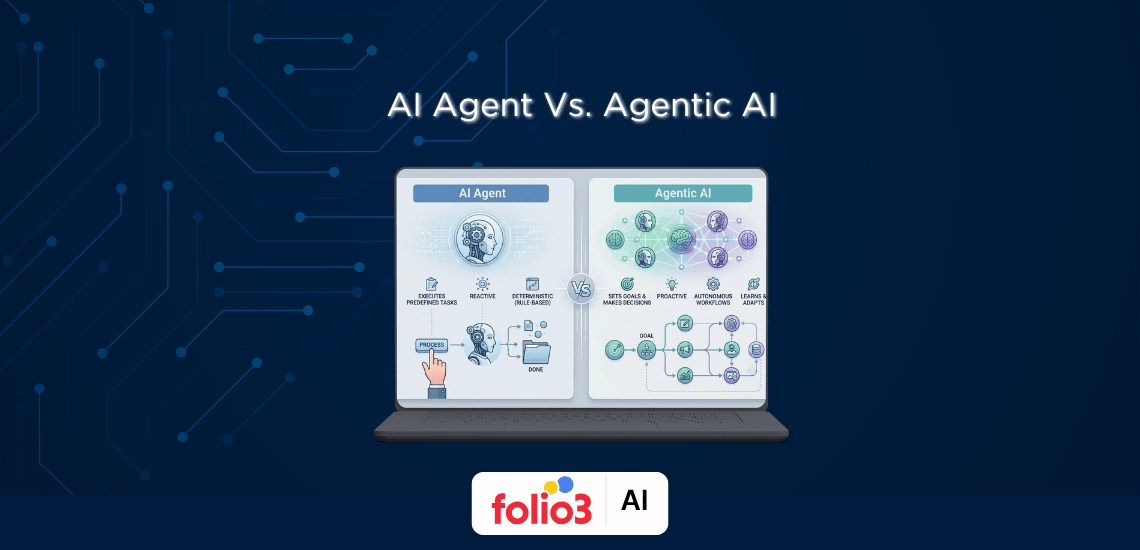
That's the agentic AI vs. AI agent difference in plain terms. An AI agent follows a defined job. Agentic AI figures out the job and the steps as it goes.
AI agent vs agentic AI: key differences
The terms aren't opposites. They're nested. Every agentic AI system uses agents. Not every agent is part of an agentic AI system. Here's how they actually compare across the dimensions that matter for buyers.
Autonomy level
An AI agent has narrow autonomy. It can decide which canned response to send or which API to call from a short list. Agentic AI has wide autonomy. It can decide what the next step even is, based on what just happened in the last step.
Task scope
AI agents handle one task or a tight family of tasks. Agentic AI handles open-ended goals where the path is not fixed. Think single-purpose versus general-purpose, with the understanding that "general" here still means "within a defined business domain."
Decision-making
An AI agent makes decisions based on the rules someone wrote. Agentic AI makes decisions about what rules to follow and when to break them, within guardrails. The guardrails are the difference between useful autonomy and a system that goes off and books 400 hotel rooms.
Coordination and orchestration
This is where the agent vs agentic AI conversation gets technical. AI agents usually work alone. Agentic AI almost always involves orchestration: a layer that routes work between agents, manages shared memory, handles conflicts, and decides when to bring in a human. Frameworks like LangGraph, CrewAI, and AutoGen exist because this orchestration is hard to build from scratch.
Adaptability over time
An AI agent does what it was built to do until you retrain or rewrite it. Agentic AI adapts within a single task, mid-execution. If the first plan doesn't work, it tries a second. That self-correction is one of the clearest signals you're looking at a true agentic system and not an agent in fancy packaging.
Architecture and components
AI agents are usually a model, a prompt, a few tool integrations, and a conversation loop, which is why custom ai agents development can start lean and expand only as the task demands it. Agentic AI adds a planner, a memory system, an orchestrator, and often multiple specialized agents with their own roles. The architecture is heavier, the failure modes are more interesting, and the testing is harder.
Custom & Pre-Built Agentic AI
Let's Build Something Intelligent Together
From complex, proprietary workflows to standard enterprise processes, our agentic AI specialists help you choose the right architecture, integrate with your existing systems, and build autonomous agents that actually work in production.
Explore Agentic AI Solutions
How does an AI agent work?
An AI agent runs through a short loop, over and over, until the task is done or it gives up. The loop is simple enough that you can usually map it out on a napkin.
Perceive the environment
The agent gets input. A user message, an API response, a sensor reading, a file. Whatever it's built to watch, it watches.
It runs the input through a model, a rule set, or both, and figures out what to do next. For LLM-based agents, this is a prompt and a response. For rule-based agents, it's a decision tree.
If the agent needs to look something up or take an action in another system, it picks a tool from its toolkit and calls it. This is where most modern agents spend their time, and it's the same reason ai agents for law firms often call a case-law database instead of a general search tool. Tool selection is a big chunk of why agents fail when they fail.
Execute a defined action
The agent does the thing. Sends the reply, books the meeting, files the ticket, flips the switch. Then the loop starts again with whatever new input comes in.
How agentic AI works?
Agentic AI runs a more complicated loop, and the loop itself can change shape based on what's happening. There's no fixed flowchart because the system writes part of the flowchart as it goes, which is part of why agentic ai adoption looks so different from one organization to the next.
Perceive across multiple sources
Instead of one input channel, agentic systems usually pull from several. A claims processing system might read the customer's email, the policy database, photos of the damage, and historical fraud data, all in one task.
Plan multi-step objectives
The system takes the high-level goal and breaks it into steps. This is the part that used to require a human business analyst. The planner agent or planning module figures out the sequence, the dependencies, and where the hand-offs happen.
Coordinate specialized agents
Different agents handle different parts. One reads documents. Another does math. A third writes the customer reply. An orchestrator passes data between them and makes sure nobody steps on anybody else's work.
Adapt the workflow dynamically
If a step fails or if new information comes in mid-task, the system adjusts. Maybe it adds a step. Maybe it goes back two steps and tries something else. This is what people mean when they say agentic AI is "non-deterministic," and it's both the feature and the risk.
Reflect and self-correct
Good agentic systems check their own work. Before sending the final output, a reviewer agent or self-reflection step asks: Does this make sense? Did we miss anything? Is this the right answer? If the answer is no, it loops back. This is also the part that most early agentic systems get wrong, because reflection is expensive in tokens and tempting to skip.
AI agent vs agentic workflow
People also ask about AI agent vs agentic workflow, which is a fair question because the terms overlap with agentic AI but mean something slightly different.
What an agentic workflow means
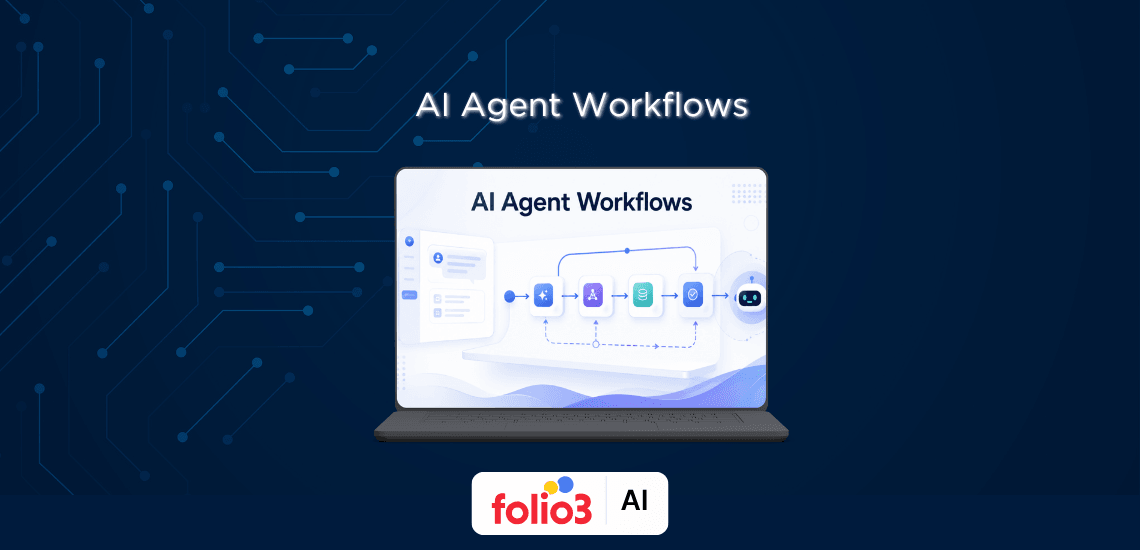
An agentic workflow is a defined business process that uses agents to execute it. It sits between a fixed RPA-style workflow and a fully autonomous agentic AI system. The steps are mostly defined, but agents handle the parts that need judgment.
Where AI agents fit inside it
Inside an agentic workflow, each step that requires reasoning or tool use is handled by an agent. The workflow itself is the scaffolding. The agents are the workers. The orchestration layer is the manager.
Why orchestration matters here
Orchestration is what keeps agentic workflows from collapsing into chaos. Without it, you have a bunch of agents calling each other with no shared state, no error handling, and no clear escalation path. With it, you have something you can actually put into production if you want to see what production-grade orchestration looks like. The Folio3 AI Agent Marketplace has pre-built agents you can compose into workflows without rebuilding the orchestration layer yourself.
Real-world examples of Agentic AI and AI Agent
Theory only goes so far. Here are four examples drawn from things that actually exist in production, two on each side of the AI agent vs agentic AI line.
AI agent example: support ticket routing
A single agent reads incoming tickets, classifies them by topic and urgency, and routes them to the right queue. It might also draft a suggested first reply. One agent, one job, clear boundaries.
AI agent example: data entry automation
An RPA-style agent watches an email inbox for invoices, extracts the line items, and posts them into the accounting system. It handles maybe 80% of invoices and flags the rest. Narrow, repeatable, easy to measure.
Agentic AI example: end-to-end claims processing
A system of agents handles a claim from intake to payout. One agent reads the claim, another pulls the policy, another assesses damage from photos, another checks fraud signals, another calculates the payout, another writes the customer letter, and a reviewer agent checks the whole thing before it goes out.
Agentic AI example: supply chain coordination
A multi-agent system monitors inventory, predicts shortages, negotiates with supplier APIs, reroutes shipments around disruptions, and escalates to a human procurement manager only when the decision exceeds a set budget. The system handles dozens of decisions a day that used to take a team.
AI Agent Marketplace
Stop Letting Tool Overload Stall Your AI Rollout
Enterprise AI projects stall when strategy, ownership, and integration are unclear from the start. Browse pre-built AI agents for HR, accounting, sales, marketing, IT help desk, and more — built to deploy fast and integrate with your existing stack.
Browse the AI Agent Marketplace
When to use an AI agent?
Not every problem needs agentic AI. A lot of the time, a single agent is the right answer, and reaching for something more complex just adds cost and failure modes.
Best-fit scenarios
Use an AI agent when the task is narrow, the inputs are predictable, and the success criteria are clear. Customer support triage, document classification, scheduled report generation, simple lookups, and standard data entry are common ai agent use cases. If a human could write the SOP on a page, an AI agent can probably run it.
Limitations to consider
AI agents struggle when the task has branches that the designer didn't anticipate. They don't plan well, they don't recover from errors well, and they don't coordinate with other systems unless someone wired them up to. If you find yourself building lots of if-then logic around an agent, you're probably outgrowing it.
When to use agentic AI?
Agentic AI earns its complexity when the problem actually needs it. The mistake I see most often is the opposite: teams pick agentic AI for problems that a single agent or a plain workflow would handle for a tenth of the cost.
Best-fit scenarios
Use agentic AI when the task spans multiple systems, takes multiple steps, has branches that depend on intermediate results, and benefits from self-correction. Claims processing, multi-step research, complex customer onboarding, supply chain coordination, and software development pipelines are good candidates.
Limitations to consider
Agentic systems are harder to test, harder to debug, more expensive to run (token costs add up fast when agents talk to each other), and harder to predict. They need real governance. If your organization can't handle a system that occasionally takes an unexpected path, you're not ready for production agentic AI, no matter how good the demo looked.
Common misconceptions about agentic AI and AI agents
A few things I keep hearing in sales calls that are worth pushing back on directly.
Are they the same technology?
No. They use overlapping building blocks (LLMs, tool calling, memory), but the architecture and behavior are different. Calling them the same thing is like calling a single car the same thing as a logistics network. The car is in the network, but the network is more than cars.
Is agentic AI just multiple agents?
Not quite. Multiple agents without orchestration, planning, and self-correction are just several chatbots in a room. Agentic AI is what you get when those agents are coordinated by something that can plan, reflect, and adapt. The orchestration is the agentic part.
Does autonomy mean no oversight?
This one is dangerous. Agentic AI shifts oversight from "human in the loop" (approving every step) to "human on the loop" (monitoring, setting boundaries, intervening when needed). It does not mean nobody is watching. Systems with no oversight are how you end up in a regulatory filing.
How to tell which one you need?
If you're trying to make this decision for an actual project, three questions will get you 80% of the way to an answer.
Map the task complexity
How many steps does the task have, and do the steps depend on each other in ways that change based on what happened earlier? If yes to both, you're looking at agentic AI. If the task is one or two steps with predictable inputs, a single agent is enough.
Assess cross-system dependencies
How many systems does the task touch? One system, one agent. Five systems with data flowing between them and decisions that depend on combining their outputs, you're in agentic territory.
Evaluate oversight requirements
How much can the system decide on its own without a human approving each step? If the answer is "almost nothing," build a workflow with an agent inside it. If the answer is "quite a bit, within limits," agentic AI is worth the investment.
Conclusion
The AI agent vs agentic AI question isn't really about which is better. It's about which fits the problem. An AI agent is a focused worker. Agentic AI is a coordinated team with a planner. Most businesses need both eventually, starting with agents for narrow tasks and moving to agentic systems as the use cases get more complex.
What you should not do is pick agentic AI because it sounds more impressive in a board deck. The systems that fail loudest are the ones that took on too much autonomy too fast, on problems that didn't need it. Start with the task, pick the smallest thing that solves it, and add complexity only when the simpler version stops being enough.
15+ Years of Advanced AI Expertise
Get a Response in 10 Minutes, Not 10 Days
Our agentic AI specialists are ready to show you how autonomous agents can be built for your operations. With 950+ projects delivered and 99% client satisfaction, we connect strategy to production — fast.
Get an Appointment Now
Frequently asked questions
Is an AI agent part of agentic AI?
Yes. Agentic AI systems are built out of agents. A single agent on its own is not agentic AI, but agents working together under an orchestration and planning layer are.
Can agentic AI exist without agents?
Not really. The agents are the workers who do the actual tasks. You could call something "agentic" if it had planning and self-correction with one very capable agent doing everything, but in practice, multi-agent setups are the norm.
Which one is more autonomous?
Agentic AI, by a wide margin. AI agents act within a defined boundary. Agentic AI sets some of its own boundaries within the rules the designer sets at a higher level.
Do they use the same underlying models?
Often yes. Both commonly use large language models like Claude, GPT, or Gemini as the reasoning engine. The difference is in what's built around the model, not the model itself.
Is agentic AI the future of AI agents?
It's where a lot of investment is going, and where the more interesting business problems sit. But single-purpose AI agents aren't going away. Plenty of work is narrow enough that one agent is the right answer, and that won't change just because the term "agentic" got popular.

-c7a98ba5-1130-4ec6-9ead-2f817af21bd7.png&w=1920&q=90)