
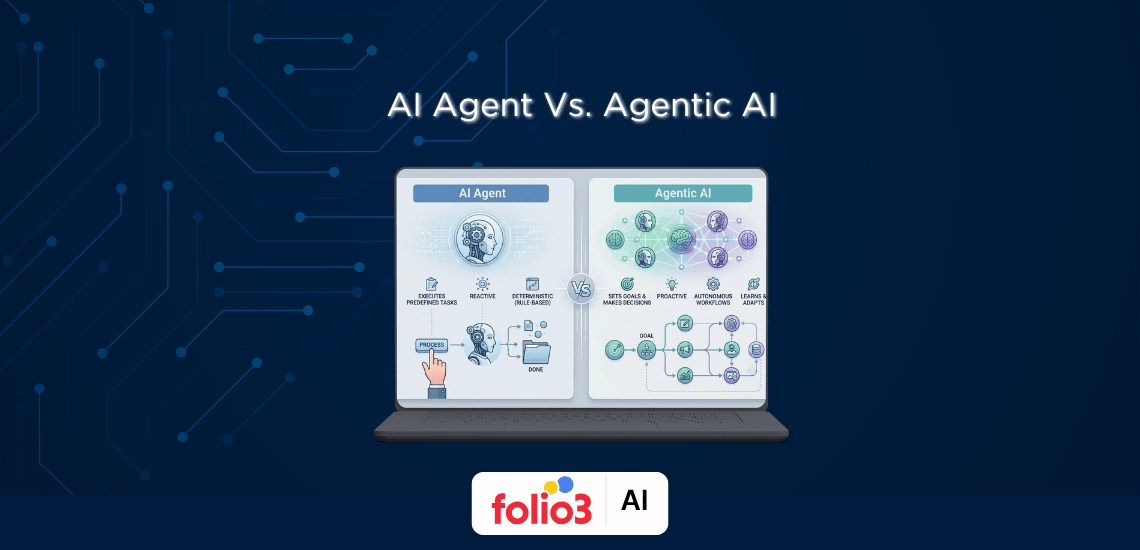
AI Agent vs Agentic AI: What's the Difference?
This guide breaks down the real difference, how each one works, when to use them, and what business owners should pick for their next automation project.
Agentic AI is transforming enterprise operations in 2026, with rapid market growth, rising adoption, strong ROI, expanding use cases, and increasing focus on governance, security, and workforce impact.
Agentic AI is a category of artificial intelligence that can think, plan, and act on its own. Unlike a chatbot that waits for your prompt and gives a response, an agentic AI system sets goals, figures out the steps to reach them, uses tools like APIs and databases along the way, and adjusts its approach when something goes wrong. It does all of this with little to no human involvement.
That distinction matters because businesses are no longer interested in AI that just answers questions. They want AI that gets work done. Customer tickets are resolved without a human touching them. Code written, tested, and deployed overnight. Marketing campaigns optimized in real time. These are the kinds of outcomes driving enterprise investment into agentic AI.
The numbers back this up. According to a Google Cloud study, more than half of executives say their organizations are actively running AI agents today. Gartner expects 40% of enterprise apps to have embedded AI agents by the end of 2026, and companies deploying these systems report average returns of 171%, per data compiled by
This article brings together the most important agentic AI statistics for 2026, pulled from credible sources. The goal is simple: give you the data you need to understand where this market is heading and what it means for your business.
Here are the seven numbers that define the state of agentic AI in 2026.
• $10.86 billion is the estimated global agentic AI market value in 2026, up from $7.55 billion in 2025. (Precedence Research)
• 40% of enterprise applications will include embedded AI agents by the end of 2026, up from under 5% in 2024. (Gartner)
• 52% of executives say their organizations are actively using AI agents right now. (Google Cloud)
• 171% is the average ROI companies report from agentic AI, with U.S. enterprises hitting 192%. (Globe Newswire via Landbase)
• 96% of IT leaders plan to expand their AI agent deployments in the near term. (MuleSoft / Deloitte)
• $2.9 trillion in annual economic value could be generated by AI agents and robots in the U.S. by 2030. (McKinsey)
• 1,041 active agentic AI companies exist globally, with over $6 billion invested in 2025 alone. (Tracxn)
The agentic AI market is one of the fastest-growing segments in all of enterprise technology. Every major research firm that tracks this space agrees on one thing: the market is expanding at compound annual growth rates above 40%, and it has already crossed the $10 billion mark.
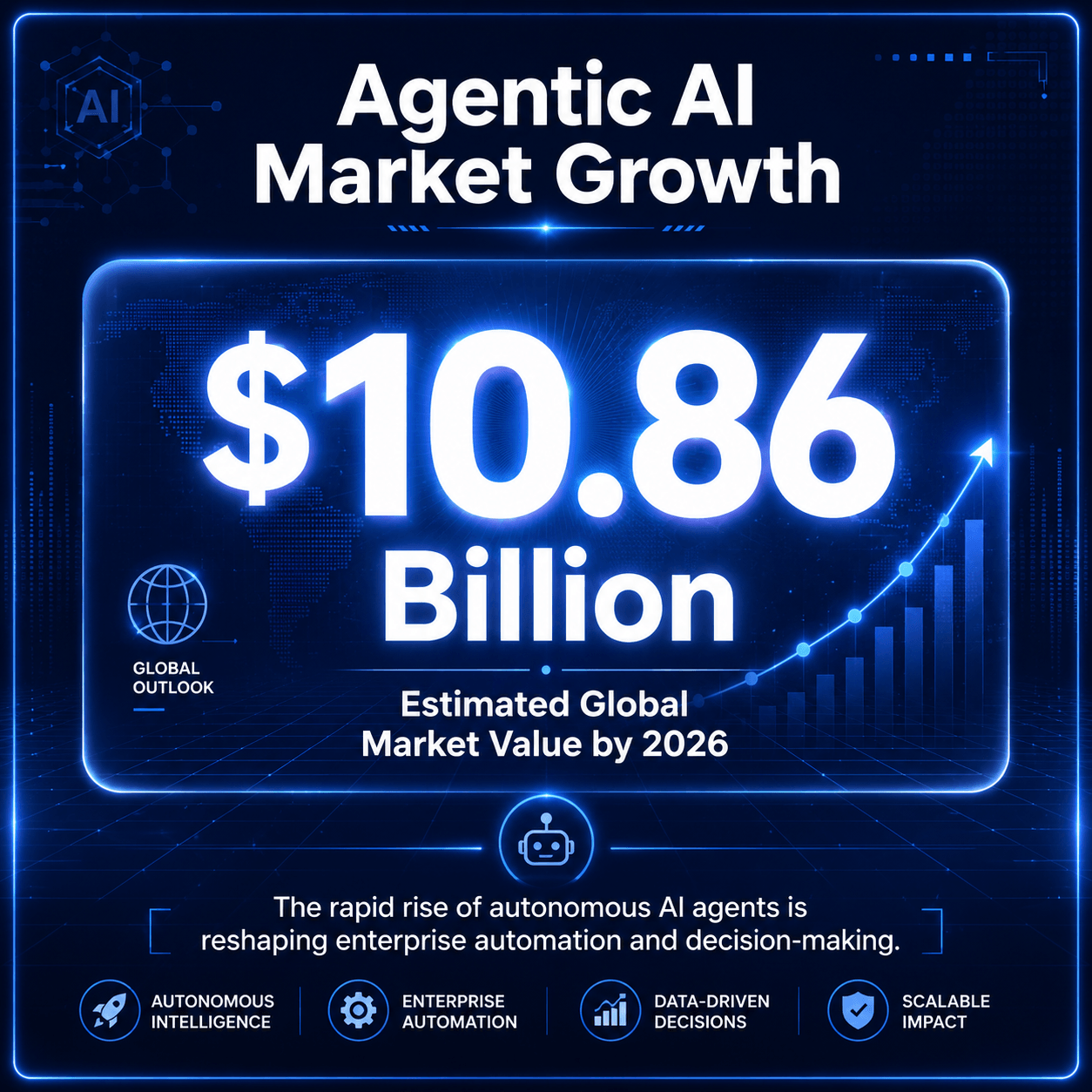
In 2024, the global agentic AI market was worth about $5.25 billion. That figure climbed to $7.55 billion in 2025. For 2026, Precedence Research puts the number at $10.86 billion. Fortune Business Insights estimates $9.14 billion, while Grand View Research lands at $10.91 billion.
The exact figures differ because each firm uses a slightly different methodology and market definition, but the direction is the same across all of them. The market has roughly doubled in under two years.
Every major forecast projects the agentic AI market to grow well past $50 billion before the end of this decade, with long-term estimates reaching close to $200 billion. Here is how the major research firms compare.
Research firm | 2026 estimate | Long-term projection | CAGR |
Precedence Research | $10.86B | $199B by 2034 | 43.84% |
Fortune Business Insights | $9.14B | $139B by 2034 | 40.50% |
Grand View Research | $10.91B | $183B by 2033 | 49.6% |
Mordor Intelligence | $9.89B | $57B by 2031 | 42.14% |
Market.us | ~$7.5B (2025) |
A CAGR above 40% means the market roughly doubles every two years. Even the most conservative estimate projects a sixfold increase by 2031.
Enterprise spending on AI agents is accelerating on two fronts. First, companies are pouring money into agent infrastructure. Mordor Intelligence reports that enterprise data-center outlays for agentic workloads range from $500,000 to $1 billion per year. Hyperscalers have committed over $300 billion to AI capital expenditure in 2025, with even bigger commitments planned for 2026.
Second, software revenue from AI agents is growing fast. Gartner projects that agentic AI could account for 30% of all enterprise application software revenue by 2035, exceeding $450 billion. That would make AI agents one of the largest revenue categories in the entire software industry.
North America holds the largest share of this market at roughly 38 to 46%, depending on the source. The U.S. alone accounts for about $2.33 billion in 2026. Asia Pacific is expected to grow the fastest, driven by manufacturing, logistics, and financial services adoption.
The conversation around AI agents has moved past "should we adopt?" For most enterprises, the question now is how fast they can scale what they have already started.
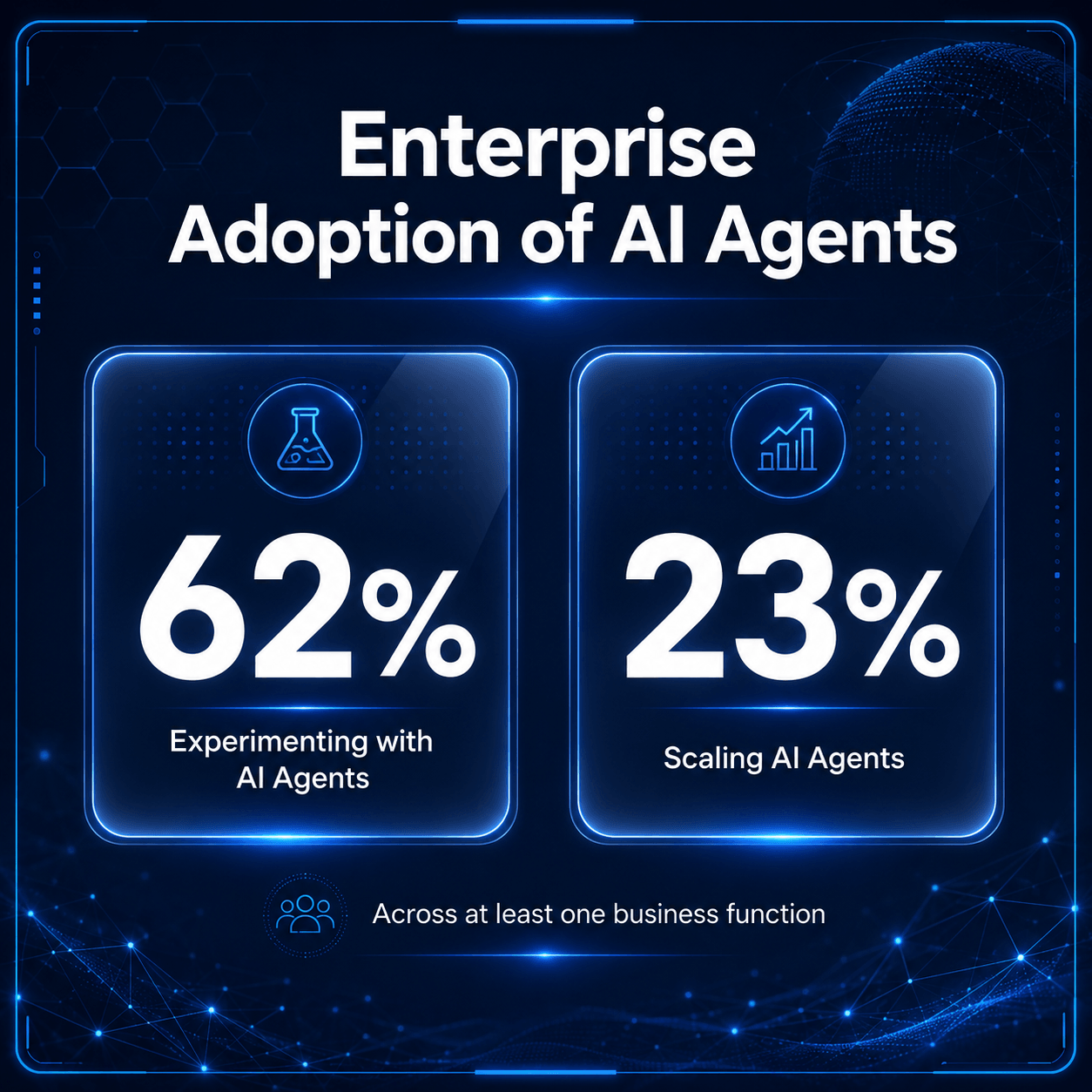
A McKinsey global survey found that 62% of organizations are experimenting with AI agents, and 23% are already scaling them in at least one business function. Google Cloud's 2025 ROI study found that 52% of executives say their companies are actively running AI agents, with 39% reporting more than ten agents in production.
The pace of change is dramatic. Gartner projects that 40% of enterprise applications will have embedded AI agents by the end of 2026, up from under 5% in 2024. ServiceNow data shows that another 43% of organizations are actively considering adoption in 2026.
Adoption rates vary by industry, shaped by regulation, workflow complexity, and how directly AI agents can impact revenue. Here is where things stand across six major sectors.
Industry | Key adoption stat |
Telecommunications | 48% adoption rate, highest across sectors |
Retail & CPG | 47% adoption; 76% increasing investment |
Healthcare | 68% have deployed an AI strategy |
Financial services | 70% of proof-of-concept activity |
Manufacturing | 69% have at least one AI use case live |
Software development | 81% of developers use AI coding tools |
Telecom and retail lead because the ROI is clear and the workflows are repeatable. Healthcare and finance are moving cautiously due to regulatory requirements, but both sectors are picking up speed. According to NVIDIA's State of AI 2026 report, every industry surveyed showed increased AI adoption year over year.
Large enterprises were the first to adopt, but small and mid-size businesses are catching up. Open-source agent frameworks and "agent-as-a-service" platforms are lowering the barriers. NVIDIA found that 58% of small companies rate open source as very to extremely important to their AI strategy.
At the other end of the spectrum, 98% of U.S. small businesses are already using at least one AI-enabled tool, according to the U.S. Chamber of Commerce. Not all of those are agentic systems, but the infrastructure and comfort level are there.
Executive buy-in for agentic AI is strong. According to Mordor Intelligence, 61% of CEOs are integrating agents into core operations, surpassing earlier RPA adoption waves.
On the implementation side, 93% of IT leaders plan to introduce autonomous agents within the next two years, per MuleSoft and Deloitte Digital. And 88% of senior executives told PwC they plan to increase AI budgets in the next 12 months, with agentic AI as the primary driver.
This is where the business case gets real. Companies deploying AI agents are not just talking about efficiency gains in abstract terms. They are reporting hard numbers on cost savings, revenue growth, and time reductions.
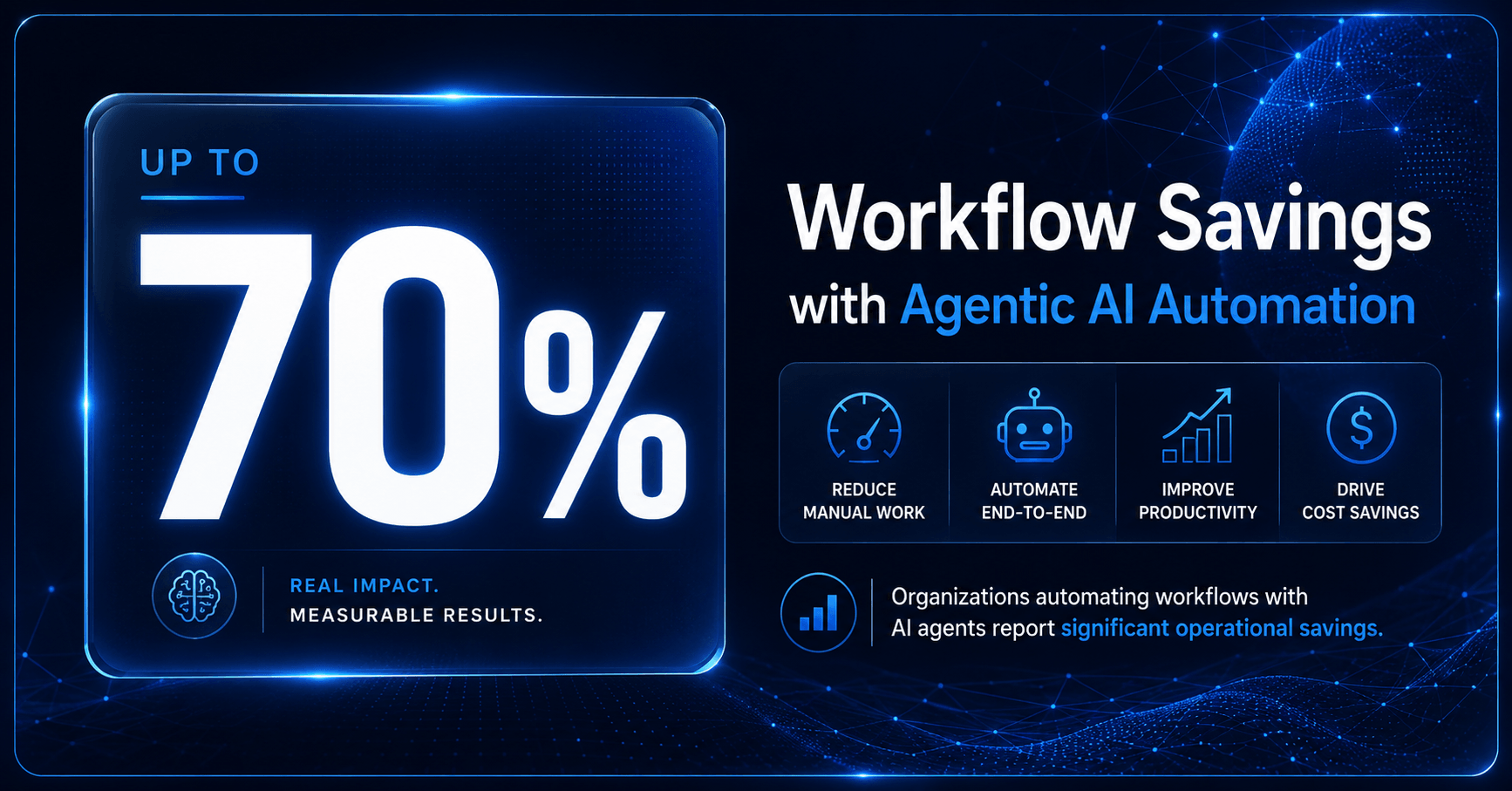
The cost reductions are significant across multiple business functions. Organizations automating workflows with agentic AI report savings of up to 70%, according to multiple enterprise surveys. In customer service specifically, companies have cut support costs by 58% while bringing average first-response time down from 4.2 hours to just 8 minutes, per data from Axis Intelligence.
The return on investment data is consistently strong across sources. Here are the key benchmarks that stand out.
What was measured | Result |
Average enterprise ROI from AI agents | 171% (192% for U.S. firms) |
Companies expecting 100%+ ROI | 62% |
Revenue increase from AI agent adoption | 6 to 10% average |
Human-AI teams vs. human-only teams | 60% more productive |
Time to resolve complex cases (ServiceNow) | 52% reduction |
Marketing operations cost savings | Up to 37% |
Google Cloud's ROI study found that 74% of executives report achieving ROI within the first year. The top three drivers of value were productivity (cited by 70% of respondents), customer experience (63%), and business growth (56%).
Customer service is the most popular use case, and for good reason. The workflows are structured, the metrics are easy to measure, and the cost savings show up quickly. About 57% of companies are either using or planning to deploy AI agents in customer service within six months.
A Forbes-recognized retailer that rolled out AI communication agents across its locations saw its annual gross profit improve by $77 million. Calls to stores dropped by 47%, and the company achieved an NPS score of 65.
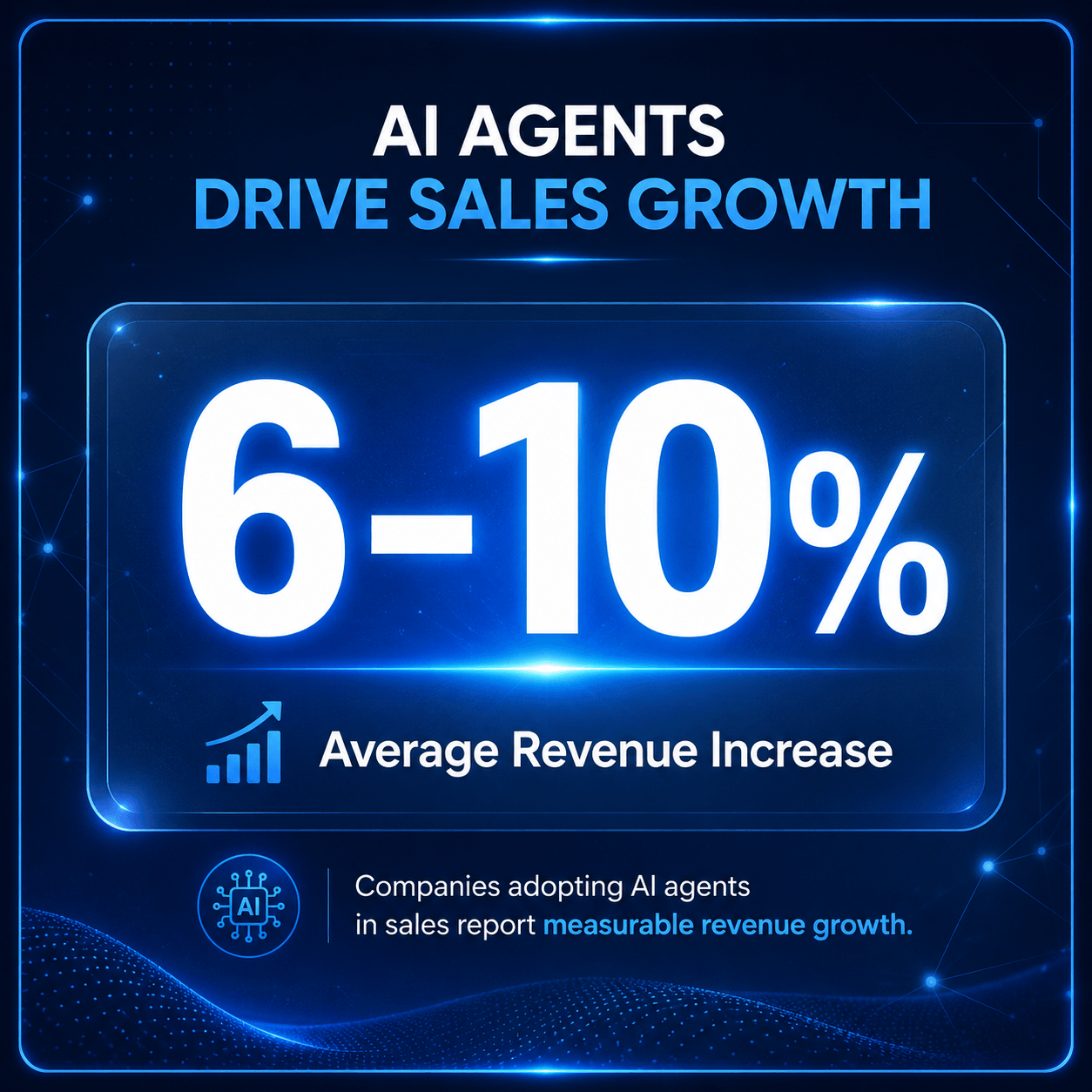
In sales, companies adopting AI agents report revenue increases of 6 to 10% on average, with overall sales ROI improving by 10 to 20%. By 2028, an estimated 68% of all customer interactions will be handled by AI agents.
The technology driving agentic AI has matured quickly. We have moved past single-purpose bots into coordinated, multi-agent systems that can plan, reason, use external tools, and handle complex multi-step workflows on their own.
According to Mordor Intelligence, multi-agent systems accounted for 53% of the market in 2025 and are growing at a 43.5% CAGR. These architectures allow specialized agents to collaborate. For example, a customer service agent can hand off to a billing agent, which then triggers a logistics agent, with no human needed in between.
By 2028, Gartner expects that 33% of enterprise software will include agentic AI, with 15% of daily work decisions being made autonomously. One-third of user interactions will shift from traditional app interfaces to agent-driven front ends.
Traditional robotic process automation (RPA) handles repetitive, rule-based tasks. AI agents handle the messy, judgment-heavy work that RPA cannot. They manage unstructured data, handle exceptions, and adapt when processes change.
The performance gap shows up clearly in the ROI numbers. Agentic AI returns exceed traditional automation by roughly 3x, according to Landbase. That is why 43% of companies are now directing more than half of their AI budgets specifically toward agentic systems, moving resources away from traditional automation.
AI agents are no longer confined to innovation labs. They are processing customer tickets, writing and testing code, running marketing workflows, and supporting sales pipelines in production environments across thousands of organizations.
Use case | Deployment stat | Key outcome |
Customer support | 57% deployed or planned within 6 months | 58% cost reduction |
Software development | 68% of AI adopters use agents here | 55% faster task completion |
Marketing automation | 61% of adopters | Up to 37% cost savings |
Sales development | 35% of CROs building AI ops teams | 6 to 10% revenue increase |
IT support | 52% of developers use AI assistants | 70% reduced dev time |
Research and analysis | 48% using AI for research tasks |
Customer service and eCommerce dominate because the ROI shows up fast and the workflows are well-defined. The fastest-growing area, though, is manufacturing and industrial automation. The global AI-in-manufacturing market is projected to reach $230.95 billion by 2034 at a 44.2% CAGR, according to Precedence Research.
In software development, GitHub found that developers using Copilot complete tasks 55% faster and report 60% higher job satisfaction. Autonomous testing agents have improved code coverage from an average of 67% to 89%.
The venture capital community has placed a massive bet on agentic AI. The funding numbers make it clear that investors see this as one of the biggest platform shifts in a generation.
A Prosus report in partnership with Dealroom.co found that agentic AI startups raised $2.8 billion in the first half of 2025 alone. The full-year figure is expected to reach $6.7 billion, representing about 10% of all AI funding rounds.
Tracxn data paints the broader picture: $18.6 billion has been invested in the sector over the past decade, with $6 billion of that coming in 2025 alone. U.S.-based startups have captured $13.8 billion of the total.
As of March 2026, there are 1,041 active agentic AI companies globally. Of those, 530 have received funding, 224 have reached Series A or higher, and 109 have made it to Series B or beyond. CB Insights has mapped over 400 AI agent startups across 16 categories.
At the other end of the scale, the broader AI sector pulled in nearly 50% of all global venture funding in 2025, totaling over $202 billion, per Crunchbase. Hyperscalers alone committed over $300 billion to AI infrastructure spending.
The headline-level debate about whether AI will "replace all jobs" misses the actual picture. The data shows a more complex reality where most roles evolve, some shrink, and new ones are created.
The World Economic Forum projects 170 million new jobs will emerge by 2030, while 92 million will be displaced. That is a net gain of 78 million positions. However, the transition will not be smooth for everyone. About 41% of employers plan workforce reductions in areas where AI can automate tasks, and 66% of enterprises are already cutting entry-level hiring.
Gartner predicts that through 2026, 20% of organizations will use AI to flatten their structures by eliminating more than half of current middle management positions. AI handles scheduling, reporting, and performance monitoring, which are tasks that traditionally required supervisory roles.
About 75% of knowledge workers already use AI tools in some form, even when their companies have not officially rolled them out, according to Microsoft's Work Trend Index. Among developers specifically, 81% are using AI coding assistants.
The incentive to build AI skills is strong. PwC's AI Jobs Barometer found that workers with AI skills earn up to 56% more than their peers. The World Economic Forum expects 39% of current worker skills to change by 2030, and 77% of employers are planning reskilling programs.
For all the positive momentum, the data also surfaces real challenges. Deploying AI agents at scale is harder than most organizations expect, and the risks are not hypothetical.
Gartner warns that over 40% of agentic AI projects face cancellation by 2027 if governance, observability, and ROI clarity are not established early. Only 34% of organizations have achieved full agentic AI deployment despite spending significant budgets. The gap between running a pilot and scaling to production remains wide.
The top three barriers are cybersecurity concerns (35% of organizations), data privacy (30%), and unclear regulation (21%). Landbase has identified 15 distinct categories of security threats specific to AI agents.
The EU AI Act is the world's first comprehensive AI regulation and is already influencing how companies build and deploy agents. Workplace AI uses, like recruitment and performance evaluation, are classified as "high risk," requiring transparency, human oversight, and worker notification.
Within the agent ecosystem, "guardian agents" that monitor other AI systems for compliance are expected to capture 10 to 15% of the market by 2030, according to Gartner. Meanwhile, 85% of organizations told NVIDIA that open source is moderately to extremely important to their AI strategy, signaling a preference for transparency and auditability.
The trajectory for agentic AI over the next decade points toward deep integration into every part of enterprise operations. Here are the key milestones that analysts and research firms are tracking.
What is expected | By when |
50% of GenAI-using enterprises deploy autonomous agents | 2027 |
33% of enterprise software includes agentic AI | 2028 |
15% of daily work decisions are made autonomously | 2028 |
AI agents handle 68% of customer interactions | 2028 |
45% of organizations run agents at scale | 2030 |
Agentic AI generates 30% of software revenue ($450B+) | 2035 |
The global market reaches roughly $199 billion | 2034 |
The pattern across all these projections is consistent. AI agents are evolving from standalone tools into the foundational layer of enterprise operations. The companies that build strong agent architectures, governance frameworks, and skilled teams now will be the ones best positioned to capture value over the next decade.
More than half. Google Cloud's research shows 52% of executives report active AI agent usage. McKinsey data puts the figure even higher when including companies in the experimentation phase, at 62%.
The most common use cases include customer support, software development, marketing automation, sales prospecting, IT support, and data analysis. Customer support leads with a 57% deployment rate, followed by software development at 68% among AI adopters.
Between $9 and $11 billion, depending on the research firm. Precedence Research estimates $10.86 billion, Fortune Business Insights says $9.14 billion, and Grand View Research puts it at $10.91 billion.
Not wholesale. The World Economic Forum projects a net gain of 78 million jobs by 2030. However, entry-level roles and middle management positions face the most disruption, with 66% of enterprises reducing junior hiring and 20% flattening management layers.
Average returns of 171%, with 74% of executives achieving ROI within the first year, according to Google Cloud. U.S. enterprises report even higher returns at 192%.
Telecommunications leads at 48% adoption, followed by retail and CPG at 47%, per NVIDIA. Healthcare (68% with AI strategy deployed), financial services (70% of proof-of-concept activity), and manufacturing (69% with live use cases) are also moving quickly.
This guide breaks down the real difference, how each one works, when to use them, and what business owners should pick for their next automation project.
AI agent workflows turn raw LLM capability into reliable systems that reason, plan, and act. This guide breaks down workflow types, tools, design steps, and best practices business owners need to build agentic AI workflows that actually ship.
-c7a98ba5-1130-4ec6-9ead-2f817af21bd7.png&w=1920&q=90)
$197B by 2034 |
43.8% |
90% report faster decisions
Explore 75 real-world AI agent use cases across healthcare, finance, insurance, retail, logistics, HR, cybersecurity, and more. Learn how AI agents move beyond chatbots to automate tasks, make decisions, and complete workflows across industries.