
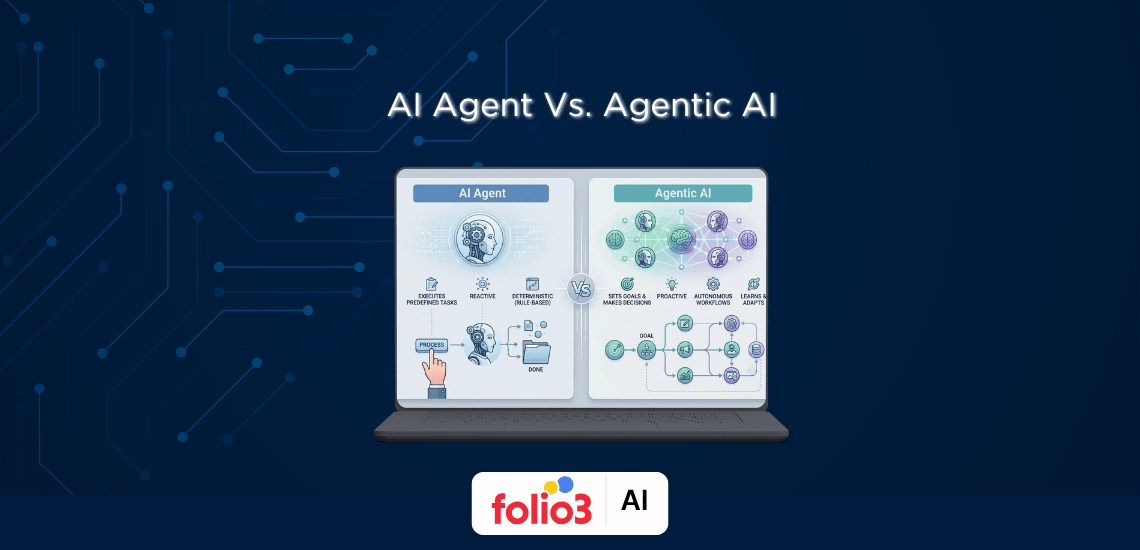
AI Agent vs Agentic AI: What's the Difference?
This guide breaks down the real difference, how each one works, when to use them, and what business owners should pick for their next automation project.
Agentic AI is changing how businesses automate work. This guide explains what agentic AI is, how it works, its key components, real-world use cases, benefits, risks, and how enterprises can deploy it responsibly in 2026.
-8a70cfe7-a0ca-42f5-a1b6-f9bde78648df.png&w=1920&q=90)
By 2026, the conversation around AI has shifted from chatbots that respond to systems that act. If you run a business, you've probably seen this firsthand. Your team is using AI to draft emails, but now there's a new question on the table: can it actually do the work, not just describe it? According to a Deloitte prediction, 25% of companies using generative AI will launch agentic AI pilots in 2025, growing to 50% by 2027. That's the shift this guide unpacks. At Folio3 Agentic AI, we help business owners figure out what agentic AI means for their operations, where it fits, and how to deploy it without losing control.
Agentic AI is a type of artificial intelligence that can pursue a goal on its own. You give it an objective, and it plans the steps, picks the tools, takes action, and checks its own work. It doesn't sit and wait for the next prompt. It keeps going until the goal is done or it hits a checkpoint that needs your approval.
The definition of agentic AI rests on four things working together: perception, reasoning, action, and learning. A traditional chatbot answers a question. An agent in AI reads the question, looks up the data, runs a process, and reports back with what it did.
Most of the value sitting inside companies is locked behind repetitive multi-step work. Pulling a report, comparing it to last month, flagging the outliers, drafting a summary, and sending it to the right people. Generative AI can help with one step. Agentic AI can do the whole sequence.
A PwC report notes that agentic AI shifts AI from a tool that assists with tasks to one that completes them, which is why enterprise interest has moved so quickly from interest to budget.
Agentic AI systems are built from a handful of layers that work together. Each one handles a different part of the loop, and removing any of them breaks the agent's ability to act on its own.
Perception is how the agent collects data from the world. This includes pulling from APIs, querying databases, reading documents, and, in some cases, taking input from sensors or screen captures. The quality of perception sets the ceiling for everything else.
Reasoning is handled by a large language model acting as the cognitive layer. The LLM weighs options, interprets context, and decides what makes sense given the goal. This is where models like GPT-5, Claude, and Gemini do the heavy lifting.
"The reasoning layer is where most teams underestimate the engineering work. Picking a capable model is the easy part. The hard part is constraining it with the right context, the right tool definitions, and the right guardrails so its decisions stay predictable inside a production workflow." — Abdul Sami, Head of AI Development, Folio3 AI
Planning breaks the main goal into smaller subgoals. If you ask an agent to onboard a new vendor, it sequences the steps: check the vendor record, request documents, route for approval, and update the ERP.
Action is where the agent calls tools and APIs to actually do things. Send the email. Update the record. Run the script. This is the difference between an assistant that suggests and an agent that executes.
Memory comes in two forms. Short-term memory holds the context of the current task. Long-term memory holds what the agent learned from past sessions, including user preferences and outcomes that worked.
Reflection is the agent reviewing its own output. Did the task complete? Did the result match the goal? Feedback loops let agents catch their own mistakes before a human has to.
Build with Folio3 AI: custom agentic AI systems that automate decisions, actions, and end-to-end business processes.
Explore Agentic AIThe way agentic AI works comes down to a loop that repeats until the goal is met. Once you see the loop, the whole category makes more sense.
The loop is Perceive, Reason, Act, Learn. The agent observes the state of the system, reasons about the next step, takes that step, and then checks the result. If the goal isn't met, the loop runs again with updated information.
A normal LLM call is single-turn. You ask, it answers, the conversation ends. An agent runs many turns inside a single user request, and most of those turns happen without you watching.
Tool calling is how the agent reaches out of the model and into your stack. The agent decides it needs to query Salesforce, formats the request, sends it, and reads the response. The Model Context Protocol (MCP), released by Anthropic in late 2024, has become a common standard for connecting agents to tools.
The orchestration layer is what holds the agent together. It manages which tool gets called, keeps state between steps, handles errors, and decides when a human needs to approve something.
Not every workflow needs a complex setup. The right architecture depends on the job.
One agent, one toolset, one goal. Good for focused tasks like answering support tickets or processing invoices. Easier to build, easier to debug, easier to trust.
Several agents work as peers. A research agent gathers, an analysis agent processes, and a writing agent drafts. They pass work between each other without a central boss.
A conductor agent assigns work to specialist agents below it. This is closer to how a manager runs a team. It scales better but adds coordination cost.
Use a single agent for narrow, repeatable tasks. Use horizontal multi-agent when steps can run in parallel. Use vertical when the workflow has dependencies and needs a clear chain of command.
People often confuse agentic AI with older automation tools. The differences matter when you're deciding what to buy.
Rule-based automation runs the same script every time. If the input changes shape, it breaks. Traditional machine learning is reactive. It classifies, predicts, or flags, but it doesn't take action across systems. Agentic AI is proactive and adapts. It can handle situations it wasn't explicitly programmed for because the LLM at its core can reason about new contexts.
The real differentiator is contextual decision-making without constant human input. RPA needs you to map every step. An agent figures out the steps as it goes.
This is the comparison most business owners ask about, so it's worth being direct.
Generative AI creates content from a prompt. You ask for a marketing brief, you get a marketing brief. Agentic AI executes goals across systems. You ask it to launch the campaign, and it drafts the brief, schedules the posts, sets up the tracking, and reports the results.
They intersect because agentic AI uses generative AI as its reasoning engine. The LLM is the brain. The agent framework is the body that lets the brain act.
Need | Use Generative AI | Use Agentic AI |
Draft a document | Yes | Overkill |
Answer a one-off question | Yes | Overkill |
Run a multi-step workflow | No | Yes |
Operate across multiple tools | No | Yes |
Make decisions based on live data | Limited | Yes |
The agentic AI use cases that are working in production today are the ones where the workflow is well-defined, the data is accessible, and the cost of an error is manageable. Folio3 has built agents across most of these categories.
Salesforce reported that its Agentforce platform handled over one million autonomous conversations within its first few months, which gives a sense of how fast adoption is moving in customer-facing functions.
Build with Folio3 AI: browse production-ready agents across sales, operations, finance, HR, and customer support.
Browse AI Agent MarketplaceThe benefits show up in three places: throughput, quality, and cost.
Throughput goes up because agents work without breaks and can handle parallel tasks. Quality improves because agents follow the same process every time and don't forget steps. Cost drops because the work that used to take a person an hour can take an agent a few minutes. A McKinsey analysis found agentic AI could unlock substantial productivity gains in knowledge work, with software engineering, customer operations, and marketing seeing the biggest impact.
Beyond the numbers, agents free your team from the parts of the job they don't enjoy. Filing tickets, chasing approvals, and copying data between systems. That work doesn't go away; the agent does it.
I want to be honest about this part because the marketing around agentic AI has gotten ahead of reality.
Errors compound. If an agent gets step one wrong, step four is going to be very wrong. Without checkpoints, you can end up with bad outcomes that nobody catches.
Sensitive data is a real risk. Agents that touch customer records, financial data, or health information need careful permission scoping. The principle of least privilege is not optional.
Tracing agent decisions is hard. When an agent makes a choice, you need to be able to ask why and get a useful answer. Most teams underinvest in observability until something breaks.
Multi-agent systems are harder to govern than single agents. More agents mean more interactions, and emergent behavior is real. Agents have surprised their builders before.
Legacy systems resist integration. If your ERP is 15 years old and doesn't have a clean API, the agent has fewer good options.
Govern first, deploy second. That's the order that works. Decide what the agent is allowed to do, what it isn't, who reviews its actions, and how you'll roll back when something goes wrong.
Human-in-the-loop checkpoints belong on any action that costs money, touches a customer, or changes data that's hard to recover. As the agent earns trust, you can relax checkpoints selectively.
Monitor everything. Every action the agent takes should be logged with enough detail that an auditor could reconstruct the decision. Build dashboards. Set alerts. Practice the rollback.
Clean data drives reliable decisions. An agent reading from a messy CRM will make messy decisions. Data quality is part of agent quality.
Ethics covers bias, accountability, and transparency. If an agent denies a loan, the customer deserves to know why, and your compliance team deserves to be able to defend it.
"Most agentic AI rollouts that stall in production don't fail because the model made a bad call. They fail because nobody could explain the call after the fact. I tell engineering teams to build the audit trail and the rollback path before they expand what the agent is allowed to touch, not after." — Aneeq Hashmi, Director of Engineering, AI and Machine Learning
The framework layer has matured quickly. The main ones to know are LangChain and LangGraph for graph-based workflows, CrewAI for role-based teams, AutoGen and Microsoft's Agent Framework for multi-agent setups, and OpenAI's Agents SDK for simpler builds.
Communication protocols matter more than people realize. MCP (Model Context Protocol) standardizes how agents connect to tools. A2A (Agent-to-Agent) covers how agents talk to each other. ACP (Agent Communication Protocol) is a broader effort to define interoperability.
When choosing a framework for enterprise use, look at observability features, support for human checkpoints, the size of the active community, and how well it integrates with your existing stack. Don't pick based on benchmark scores alone.
Agentic AI is the version of AI that does the work instead of describing it. The technology is real, the use cases are running in production, and the cost of waiting is starting to show up in competitor benchmarks. The companies getting this right are not the ones with the biggest budgets. They're the ones who picked a narrow workflow, built guardrails before they built capability, and kept a human in the loop for the decisions that mattered.
Build with Folio3 AI: talk to our team about identifying high-value agent opportunities and building a path to production.
Talk to Our Agentic AI TeamAgentic AI is an AI system that can plan, take action, and complete multi-step tasks on its own to reach a goal you give it.
A chatbot answers questions. An agentic AI system uses tools, takes action across systems, and finishes the task.
An AI agent is a single autonomous unit. Agentic AI is the broader category that includes single agents and multi-agent systems.
No. Agentic AI is narrow and goal-specific. AGI would match human reasoning across any domain, which doesn't exist yet.
Customer service, financial services, healthcare, software development, and supply chain are seeing the fastest adoption.
Compounding errors, data leaks, unauthorized actions, and decisions you can't audit or explain.
For most business owners, starting with prebuilt agents from a platform like the Folio3 AI Agent Marketplace is faster and cheaper than building from scratch.
This guide breaks down the real difference, how each one works, when to use them, and what business owners should pick for their next automation project.
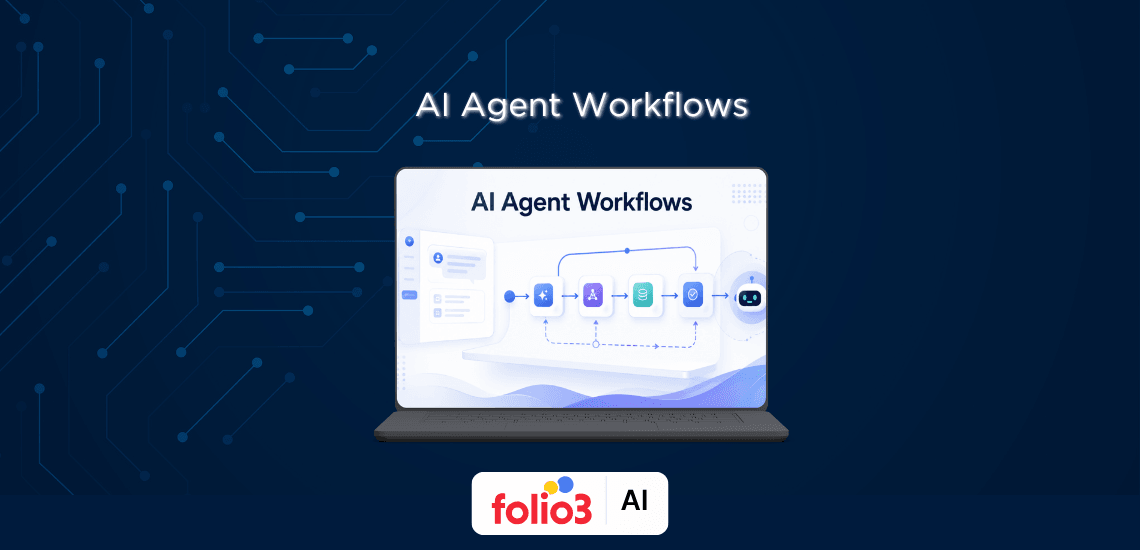
AI agent workflows turn raw LLM capability into reliable systems that reason, plan, and act. This guide breaks down workflow types, tools, design steps, and best practices business owners need to build agentic AI workflows that actually ship.
Agentic AI is transforming enterprise operations in 2026, with rapid market growth, rising adoption, strong ROI, expanding use cases, and increasing focus on governance, security, and workforce impact.