
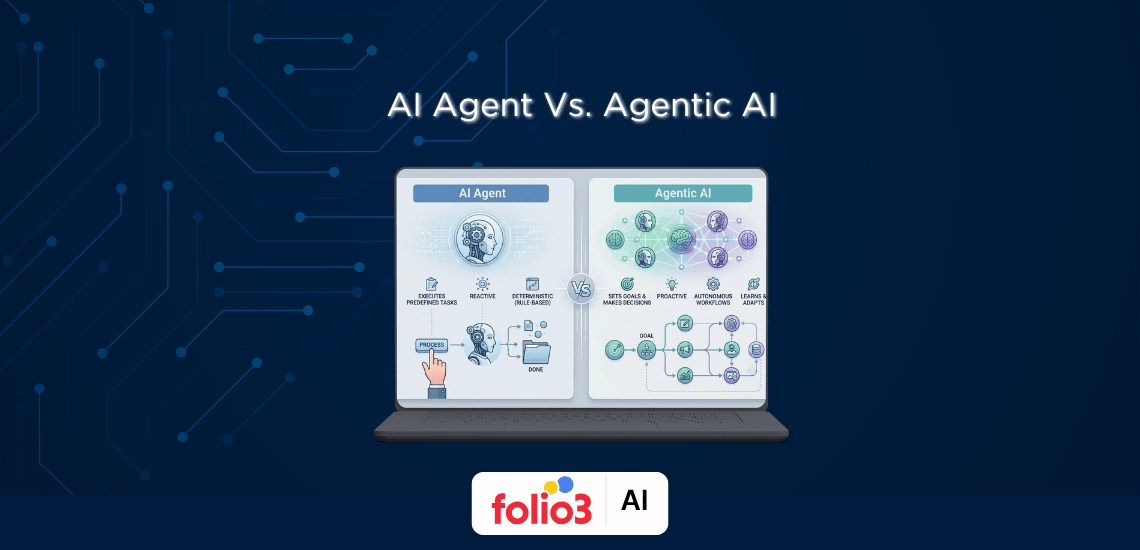
AI Agent vs Agentic AI: What's the Difference?
This guide breaks down the real difference, how each one works, when to use them, and what business owners should pick for their next automation project.
A multi-agent AI system uses specialized agents that work together to handle complex workflows. This guide explains how MAS works, its architectures, use cases, frameworks, and when businesses should use it.
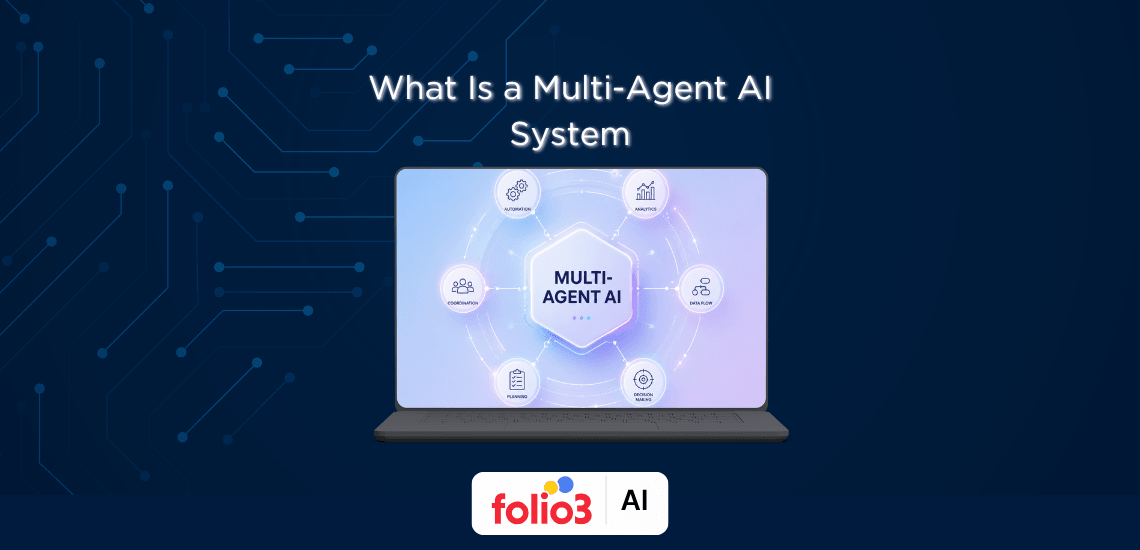
Most business owners I talk to are not asking whether AI works anymore. They are asking why their single chatbot keeps falling over the moment a request gets even slightly complicated. That is the real reason multi-agent setups are getting attention. According to Gartner's 2024 forecast, by 2028, around 33% of enterprise software applications will include agentic AI, up from less than 1% in 2024. That is a fast jump, and it tells you where serious budgets are heading. At Folio3 Agentic AI, we build these systems for companies that have already hit the ceiling of what one model can do. A multi-agent AI system is how you break through that ceiling, and this post walks through what it is and how it actually works.
A multi-agent system, often shortened to MAS, is a setup where two or more AI agents work together on a task. Each agent has its own job, its own tools, and its own way of making decisions. They share information, hand off work, and sometimes argue with each other before producing a final answer.
The reason this matters for business owners is simple. Before getting into the mechanics, understanding agentic ai basics helps frame why architecture decisions matter at scale. A single agent has to be a generalist. It tries to be okay at everything. A multi-agent AI system lets you have specialists, the same way a real company does. One agent reads documents. Another writes drafts. A third checks the math. The work gets better because nobody is stretched thin.
This is also why the term keeps showing up in product roadmaps. IBM, Google, Salesforce, and Microsoft have all shipped tooling for it in the last 18 months. The shift is happening whether or not any individual company is ready for it.
Before you can plan one, you have to know what is actually inside it. Five pieces show up in almost every multi-agent AI design, and skipping any of them tends to cause problems later.
Each agent is a piece of software with a defined job. One might be a research agent that searches the web. Another might be a writer. A third might be a reviewer who catches errors. Roles need to be narrow. Vague roles produce overlapping work and wasted tokens.
The orchestrator is the agent that decides who does what and when. It reads the incoming request, breaks it apart, sends pieces to the right specialists, and then puts the results back together. Without an orchestrator, agents tend to talk past each other.
"The orchestrator is the piece that teams skimp on early and regret later. It does not need to be complicated on day one, but it needs to exist from the start. Bolting coordination logic on after you already have three or four agents talking past each other is a much harder rebuild than just starting with one." — Abdul Sami, Head of AI Development, Folio3 AI
Agents need a place to read and write information that other agents can see. This is usually a vector database, a key-value store, or a structured scratchpad. Shared memory is what lets the writer agent know what the researcher already found, so the researcher does not have to repeat it.
Agents need a format for messages. Free-form text works in demos and breaks in production. Structured messages, usually JSON with defined fields, are what teams use once they are past the prototype stage. Anthropic's Model Context Protocol and Google's Agent-to-Agent protocol are two efforts to standardize this.
Agents are not much use if they cannot do anything. Tools are how they reach into the real world: calling your CRM, querying a database, sending an email, running code. Each agent should only have access to the tools it actually needs. Giving every agent every tool is a security mistake.
The flow is easier to follow if you watch what happens when a user makes one request. Here is the path it takes through a typical system.
A user submits a request. It could be "find me three suppliers for this part and check their certifications," or "draft a sales email for these 50 leads." The request hits the orchestrator first.
The orchestrator reads the request and breaks it into smaller pieces. The supplier task gets split into search, certification check, and summary. The orchestrator decides the order and which agent handles each piece.
Each subtask is sent to the agent best suited for it. The search agent gets the search step. The verification agent gets the certification step. Each one runs with its own prompt, tools, and sometimes its own underlying model.
Agents do their work, write results to shared memory, and read what other agents have written. If one agent's output is missing something, another agent can flag it and ask for a redo. This back and forth is where multi-agent systems earn their keep.
The orchestrator collects everything, resolves any conflicts, formats the final answer, and sends it back to the user. The user sees one clean response, not the messy conversation that produced it.
Build with Folio3 AI: agentic systems that take action, integrate with your stack, and deliver measurable outcomes.
Discover Agentic AIThere is no single way to wire these systems up. The four patterns below cover most of what teams actually build, and each one fits a different kind of problem.
One agent runs the show. It decides everything. This is the most common pattern because it is the easiest to debug. CrewAI and most early production systems use this. The downside is that the orchestrator becomes a bottleneck and a single point of failure.
Agents talk to each other directly, with no central boss. This is closer to how human teams sometimes work, where anyone can ping anyone else. It scales well but is harder to control. Decentralized setups are common in research and in simulations of markets or traffic.
Layers of management. A top-level agent delegates to mid-level managers, who delegate to workers. This fits large enterprise workflows where one request might touch ten different departments. It also matches how companies are already structured, which makes it easier to map to existing processes.
A mix. Some parts of the workflow are centrally controlled, others let agents act on their own. Most real production systems end up here once they grow past the prototype stage. The pure patterns are easier to draw on a whiteboard, but the hybrid is what survives contact with messy business reality.
Plenty of teams jump to multi-agent before they need it. That is expensive and slow. The honest comparison below should help you figure out which one fits your situation.
If the task is linear, short, and well-defined, one agent is fine. Answering customer questions from a knowledge base, summarizing a document, and classifying an email. These do not need multiple agents, and adding them just burns money.
When the task has several stages that need different skills, when accuracy matters enough that you want one agent checking another, or when the work can be done in parallel, multi-agent makes sense. Sales research, compliance review, code generation with testing, and supply chain optimization all fit.
Capability | Single-agent | Multi-agent |
Task complexity | Low to medium | Medium to very high |
Cost per request | Lower | Higher |
Latency | Faster | Slower, more steps |
Error correction | Limited | Built in through review agents |
Debugging difficulty | Easier | Harder |
Scalability of skills | Adding skills bloats one prompt | Add a new agent |
Pick a single agent if you can write the task on a sticky note, and it fits. Pick multi-agent if the task has clear sub-steps, needs review or verification, or requires more than one type of tool. If you are unsure, start single-agent and add agents only when you hit a real ceiling. Folio3's team has seen plenty of clients spend three months building elaborate multi-agent systems for problems that one well-prompted agent would have handled. Whether you go single or multi-agent, the quality of your outcomes depends heavily on the custom AI agent development approach you choose from day one.
Not every agent in a multi-agent system pulls its weight. The ones that do tend to share four properties that researchers in this field have been writing about for decades.
An agent should make its own small decisions without checking in. If it has to ask the orchestrator about every step, it is not really an agent. It is a function call with extra words.
Agents need to notice when something changes. A new document arrives, an API returns an error, a user updates their request. Good agents respond to these without being told.
An agent should hold onto its goal even when the path gets messy. If the first approach fails, it tries another. Reactive without proactive gives you an agent that flinches at every input and never finishes anything.
The agent has to be able to talk to other agents in a format they understand. This sounds obvious, but it is one of the most common failure points. Agents that write beautiful prose but cannot produce clean, structured output break multi-agent systems.
The pattern is showing up across industries. The examples below are the ones I see most often, and they are the ones business owners ask about by name.
Agents represent suppliers, warehouses, and transport routes. They negotiate in near real time to cut delays. According to a McKinsey analysis, companies that have adopted AI in supply chain operations have reported logistics cost reductions of 15% and inventory reductions of 35%. Multi-agent systems are how the more advanced versions of this work.
A triage agent reads the patient intake. A retrieval agent pulls related cases. A reasoning agent suggests a differential. A reviewer agent flags risk. The doctor stays in the loop and makes the call. This is how ai agent healthcare workflows are being deployed in practice. The agents handle the paperwork and the cross-checking.
One agent watches transactions. Another runs them against regulatory rules. A third flag exceptions for human review. Compliance work is repetitive and high-stakes, which is exactly the shape that multi-agent setups are good at.
A triage agent classifies the incoming ticket. A retrieval agent pulls the right docs. A response agent drafts a reply. An escalation agent decides if a human needs to step in. This is the most common production deployment of multi-agent AI right now.
Agents propose hypotheses, search literature, run small analyses, and write up findings. Labs at Stanford and Google DeepMind have been publishing on this pattern since 2023.
"Debugging a single agent is hard enough. Debugging a conversation between five agents, where the bug only shows up after three handoffs, is a different category of problem. Teams that treat tracing as an afterthought end up rebuilding their entire logging layer halfway through a project, usually right after a production incident forces the issue." — Aneeq Hashmi, Director of Engineering, AI and Machine Learning
You do not have to build the plumbing from scratch. Five frameworks cover most of what teams use today, and each one is good at something a little different.
The right framework depends on your stack and your team. If you want help picking, the AI Agent Marketplace has prebuilt agents that work across several of these frameworks.
Before you commit to building one, it is worth knowing what tends to go wrong. The five issues below are the ones that catch most teams off guard.
More agents mean more messages, more tokens, and more chances for two agents to step on each other. If you are not careful, your system spends more time coordinating than working.
When something breaks, you have to trace it through several agents and their conversations. Standard logging is not enough. You need tracing tools built for this specifically.
Each agent is a potential entry point. If an agent has access to your database and a user can manipulate its input, you have a problem. Treat agents like microservices with their own permissions.
Agents can develop interaction patterns nobody designed. Sometimes that is creative problem-solving. Sometimes it is two agents agreeing to do nothing and reporting success. You have to test for both.
A two-agent demo that works on your laptop is not the same as a 20-agent system handling thousands of requests a day. Cost, latency, and reliability all get harder as you scale.
These are the rules of thumb that come up in almost every project we run at Folio3. They will not eliminate the hard problems, but they will keep you out of the easy ones.
Multi-agent AI is not magic, and it is not the right fit for every problem. For the right kind of work, though, it is a real step up from single-agent setups, and the gap is widening every quarter. If your team is hitting the ceiling of what one model can do, this is the next move worth taking seriously.
Build with Folio3 AI: a strategy session to identify the right use cases and move from idea to deployment.
Book a Strategy CallA single-agent AI handles one task at a time with one model. A multi-agent system uses several specialized agents that share information and hand off work, which lets it handle longer and more complex workflows.
Agents with defined roles, an orchestrator, shared memory, communication protocols, and access to tools and APIs. Skip any of these, and the system gets fragile fast.
Supply chain, healthcare, financial services, customer support, and research are the early leaders. Any industry with multi-step workflows and a need for accuracy is a candidate.
LangGraph, CrewAI, Microsoft AutoGen, OpenAI Agents SDK, and Google ADK are the main ones. Each fits a different kind of project.
When the task is simple, linear, or low-volume, a single well-prompted agent is cheaper, faster, and easier to debug. Move to a multi-agent system only when the single-agent version stops being enough.
This guide breaks down the real difference, how each one works, when to use them, and what business owners should pick for their next automation project.
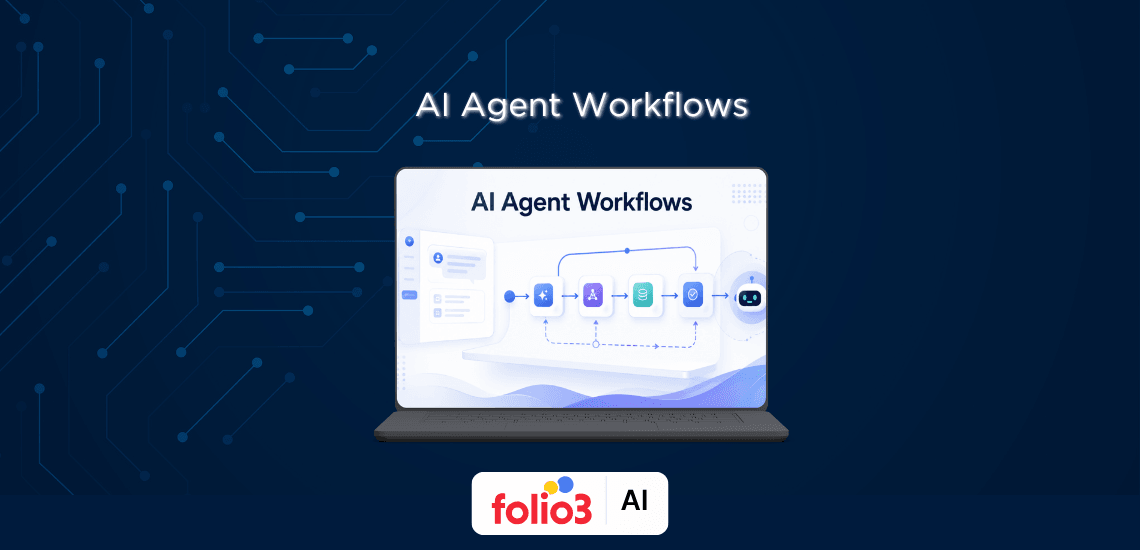
AI agent workflows turn raw LLM capability into reliable systems that reason, plan, and act. This guide breaks down workflow types, tools, design steps, and best practices business owners need to build agentic AI workflows that actually ship.
Agentic AI is transforming enterprise operations in 2026, with rapid market growth, rising adoption, strong ROI, expanding use cases, and increasing focus on governance, security, and workforce impact.